Disclaimer: Cryptocurrency investment carries a high level of risk, this tutorial is only a guide and does not constitute any investment advice. Please make sure that cryptocurrency trading is allowed in your region and be aware of the risk to your money.
##In November 2025, a meeting led by the People's Bank of China (PBOC) and attended by the Ministry of Public Security (MPS), the Supreme Court, the Supreme Prosecutor, and 13 other departments released a clear signal: Stablecoin is a form of virtual currency, and its related business activities are all illegal financial activities.
This is a rare official so directly to the stablecoin "name". Four years have passed since the 924 notice in 2021, a comprehensive crackdown on virtual currencies, but for many cryptocurrency practitioners and investors, a confusion still exists: stablecoin is not different from BTC, ETH and these "speculative" cryptocurrencies, which are anchored to fiat currencies and have a relatively stable price, so why would it also touch the regulatory red line? Why would it hit the regulatory red line?
In most parts of the world, stablecoins are moving towards compliance. The US passed the GENIUS Act in July 2025, the EU's MiCA regulation came into effect in 2024, and Singapore and Hong Kong have established corresponding regulatory frameworks. But on the mainland, stablecoin remains a red line that cannot be crossed.
Where does this red line come from? How does it land in enforcement? What risks do ordinary people face when holding or trading USDT? This article tries to present a complete picture through policy documents, real cases and international comparisons.
Three Red Lines: Why Stablecoins Touch Core Interests
Stablecoin is being slashed across the board not because it is a cryptocurrency, but because it touches three red lines: monetary sovereignty, capital controls and financial stability.
1. Monetary Sovereignty: Challenging the Legal Status of RMB
Circular 924 of 2021 clearly states, "Virtual currencies such as bitcoin, ethereum, tadcoin, and other virtual currencies, regardless of their names, do not have legal tender and should not and cannot be used as currencies circulating in the market."
While the stablecoin is anchored to the U.S. dollar, it is essentially a digital asset issued by a private company that lacks the credit backing of the state. When it is widely used for payments and settlements within the country, it is in fact "competing with the RMB for circulation space". This is unacceptable for a country with a population of 1.4 billion that wants to internationalize the yuan.
What's more, China is pushing for its own digital currency, the digital Chinese yuan (e-CNY). The presence of stablecoins is undoubtedly a competitive distraction. Cracking down on stablecoins also removes a major obstacle to the development of the digital RMB.
2. Capital controls: a tool to bypass foreign exchange management
The most scary thing for regulation is the capital transfer that cannot be directly intervened.
China has a capital control policy, with an annual limit of $50,000 for individuals to purchase foreign exchange. But USDT provides a simple "bypass path": use RMB to buy USDT, and then exchange it for US dollars or other currencies outside the country. This process does not go through the banking system, and the Foreign Exchange Bureau has no record of it.
In December 2024, the State Administration of Foreign Exchange (SAFE) issued a document requiring banks to strengthen the reporting of foreign exchange risk transactions, in which "illegal cross-border financial activities of virtual currencies" was explicitly listed as foreign exchange risk behaviors that require attention. This is not an idle rumor. According to public reports, in a case pronounced by the Shanghai Pudong Court in July 2025, a criminal group realized the cross-border illegal exchange of RMB and foreign currencies by operating accounts of domestic shell companies and providing customers with stable currencies such as USDT, involving an amount of more than six billion.
A practitioner who has worked on offshore exchanges told me that at peak times, he could see hundreds of thousands of dollars of USDT being transferred out of Chinese user addresses every day. "This is a large portion of the traffic, and there's no way officials don't know about it."
3 Financial stability: a source of systemic risk
The third regulatory concern is the financial risk of the stablecoin itself.
That November 2025 meeting made it clear that stablecoins "cannot meet the requirements of customer identification, anti-money laundering, etc., and there is a risk that they will be used for illegal activities such as money laundering, fund-raising fraud, and illegal cross-border transfer of funds." In fact, stable coins have become the tool of choice for black and gray industries such as telecom fraud, online gambling, and underground money laundering.
In August 2024, the Supreme Court and the Supreme Prosecutor jointly issued a judicial interpretation that for the first time explicitly listed "trading through virtual assets" as a way of money laundering. This means that the use of USDT to transfer stolen money is no longer a gray area, but a clear criminal act.
A lawyer friend shared a detail with me: "Now a lot of OTC merchants' bank cards are frozen because they have received fraudulent funds. But many people think they are just selling USDT, how is it illegal?" The problem is that the law doesn't recognize "lack of knowledge" - when your trading behavior meets certain characteristics (large amounts of cash, unusual prices, continuing after the account has been subject to a windfall), the court will find that you "ought to have known "suspicious source of funds.
ii. policy evolution: from ambiguity to clarity
China's regulatory attitude towards stablecoins has gone through a process of gradual clarity.
2013: The Vague Stage
Bitcoin had just entered China, and regulators defined it as a "virtual commodity," allowing ordinary people to buy and sell freely at their own risk, but prohibiting financial institutions from participating directly. At that time, stable coins had not yet appeared, and the plate was mainly "volatile assets" such as BTC.
2017: The first full ban
With the rise of ICOs, regulators realized that most of these projects were frauds. The People's Bank of China and seven other departments jointly issued the "Announcement on Preventing the Risks of Token Issuance and Financing", which completely banned ICOs and required domestic exchanges to shut down. This was the first time that regulation in China was "sweeping".
However, at that time, stablecoins were just starting out (USDT was launched in 2014) and had a small market capitalization, so they were not yet singled out.
September 2021: Circular 924 - Stablecoins are explicitly included in the crackdown
This is the turning point. The People's Bank of China and 10 other departments jointly issued the Circular on Further Preventing and Disposing of the Risks of Virtual Currency Trading Speculation, which for the first time listed "Tidecoin (USDT)" alongside Bitcoin and Ether, making it clear that it is a virtual currency, and declared:
Any business activities related to virtual currencies are illegal financial activities.
This includes: virtual currency exchange, trading, the provision of services for virtual currency transactions, token issuance and financing, as well as the trading of virtual currency clothing and products. The Circular also emphasizes that the provision of services by offshore exchanges to residents in China is also considered illegal.
After the release of the 924 notice, the domestic exchanges fully retired Chinese users, and banks began extensive wind control of accounts involved in OTC transactions. However, by this time the market capitalization of stablecoins had already exceeded $10 billion, and underground trading was still active.
2024-2025: Law Enforcement Escalates, Stablecoin Is Separately Characterized
In August 2024, the Supreme Court and the Supreme Prosecutor listed "trading through virtual assets" as a method of money laundering, providing a clear legal basis for OTC-related cases.
In November 2025, the People's Bank of China (PBOC) convened a meeting with multiple departments to define for the first time that "Stablecoin is a form of virtual currency" and to clarify that there is a "risk that it may be used for money laundering, fund-raising fraud, and cross-border transfer of funds in violation of the law. This tone, fundamentally.
This tone fundamentally seals the possibility of stablecoin compliance in China.
Case Analysis: How the Red Line Comes Down
Policy documents are one thing, and the reality of enforcement is another. Below are a few publicly reported real-life cases that demonstrate the many ways in which ordinary people can run afoul of the law as a result of their involvement with USDT.
Case 1: Illegal Business Offense - "Trading Foreign Exchange in Disguise"
The case of Zhao Dong: The fall of the so-called "first man of OTC".
Zhao Dong was once a well-known figure in China's cryptocurrency circles, and had long been engaged in large-value OTC trading. The court found that his team's provision of foreign currency and RMB exchange services through the medium of virtual currencies constituted the crime of illegal business operation, and he was ultimately sentenced to 7 years in prison.
The logic of this case lies in the fact that when you use USDT as an intermediary medium to realize the cross-border exchange of RMB and foreign currencies, it is regarded as "trading foreign exchange in disguise", which is strictly controlled by China.
Chongqing He Mou Case: 14 Billion Transaction Flow, Sentenced to 3 Years in Prison
As an OTC merchant on an exchange, He Mou bought and sold USDT in large quantities for domestic users, with a total transaction flow of 14 billion RMB. The court held that He provided recharge and exchange services for the virtual currency trading platform in disguise, which was illegal to engage in funds payment and settlement business, constituting the crime of illegal business operation, and sentenced him to 3 years' imprisonment and a fine of 5 million RMB.
It is worth noting that He himself may have thought that he was only trading, but the court found that he "played the role of a counterparty", essentially providing payment and settlement services for the platform.
Case 2: Concealment and concealment of proceeds of crime - the "ought to have known" principle
Beijing Liu case: 200,000 cash, Yuan 3.5 years
In 2024, Liu, a Beijing man, sold USDT over-the-counter and received 200,000 yuan in cash in person, which was later proven to be the proceeds of wire fraud. The court held that his use of large cash transactions in person and unusual prices met the conditions of "reasonably should have known" that the funds were of suspicious origin, and he was ultimately sentenced to three and a half years in prison for the crime of disguising or concealing the proceeds of crime.
The court made it clear that the defense of "lack of knowledge" is difficult to establish in the face of unusual transactions.
The case of "Xiaoming": bank card was frozen, but still continued to trade
In another case, after a merchant under the pseudonym "Xiaoming" sold USD 200,000 worth of USDT, some of the money was found to be fraudulent funds. Although his lawyer argued that the transaction itself was not illegal and that he had no knowledge of the transaction, the court noted that , given Ming's previous experience of having his bank card frozen in connection with wire fraud, the court found that he had committed a crime because he knew that he was likely to receive stolen funds.
The takeaway from this case is that once your account has been winded or frozen, continuing to trade is a clear signal of risk.
Case 3: Crime of Helping Information Network Criminal Activity ("Helping Trust Crime")
Gansu 10-member gang case: knowing it was gambling funds, they still exchanged them at a high exchange rate
In September 2024, a court in Gansu Province sentenced 10 "coin dealers" to prison terms ranging from 10 months to one year. The group, led by Shen Mou, set up a studio specializing in over-the-counter (OTC) trading of USDT via Telegram and other platforms. They knew that the cryptocurrencies were derived from illegal activities such as online gambling and telecommunication fraud, but converted them to fiat currencies at a high exchange rate for profit, and were ultimately convicted of the crime of "helping the trust".
The key to this case is "knowledge". When you know that the other party's funds originate from cybercrime, but still provide exchange services, you are "helping" the crime.
Case 4: Large Cross-Border Case - Shanghai USDT 6.5 Billion Case
In July 2025, the Pudong Court in Shanghai sentenced an illegal business case. The criminal group provided USDT and other stable currencies to customers through the operation of domestic shell company accounts, realizing the cross-border illegal exchange of RMB and foreign currencies, involving an amount of more than 6 billion.
This is a typical case of illegal trading of foreign currency using stablecoins in recent years, and a scenario most feared by regulators.
These cases show that those involved in USDT may face three kinds of crimes: the crime of illegal business operation, the crime of disguising and concealing the proceeds of crime, and the crime of helping the letter. Think you're just trading? The law doesn't see it that way.
IV. International Comparison: China's Uniqueness
While China characterizes stablecoin as an "illegal financial activity," other major economies around the world are actively building regulatory frameworks and trying to bring them into compliance.
The United States: "Licensed + Fully Reserved"
In July 2025, the U.S. passed the Guiding and Establishing National Innovations in U.S. Stablecoin Act (GENIUS Act), which established a comprehensive federal legal framework for payment-based stablecoins.
At the core are two things: issuers must be approved by federal or state regulators and those over $10 billion in size must be federally regulated; 100% reserves and each stablecoin must be backed by one-for-one high quality liquid assets. Business is severely restricted, with high-risk activities such as lending and Staking prohibited. Legal status is also clarified: stablecoins are not considered "securities" or "commodities", avoiding regulatory overlap between the SEC and CFTC.
EU: MiCA Regulation Harmonizes Markets
In June 2024, the EU's Markets in Crypto Assets Regulation (MiCA) will come into force.
It divides stablecoins into two categories: "asset reference tokens" (ARTs, zinc fixed basket of currencies/commodities) and "electronic money tokens" (EMTs, zinc fixed single fiat currencies.) EMTs issuers must be licensed credit institutions or e-money institutions ; ARTs are subject to authorization by the competent authorities of the Member States. Reserve assets must be segregated from the issuer's own assets and held in escrow by a third party. The EU is very cautious about algorithmic stablecoins that lack realistic asset reserves.
Singapore: flexible and pragmatic
The Monetary Authority of Singapore (MAS) published in August 2023 a specialized Stablecoin Regulatory Framework.
It focuses on single-currency stablecoins, mainly for stablecoins pegged to the SGD or G10 currencies. Issuers will need to obtain a Payment Institution License and a MAS permit. Reserve requirements are stricter than in the US: reserves can only be invested in cash, short-term government bonds, excluding money market funds. Mixed operations are also prohibited, as are lending and asset management.
Hong Kong: the "offshore window" for the mainland
Hong Kong formally implemented the Stablecoin Ordinance in August 2025, which implements a licensing regime for stablecoin issuance. This creates a "dual-track" pattern of developing a central bank digital currency (e-CNY) on the mainland and exploring offshore stablecoin innovation in Hong Kong.
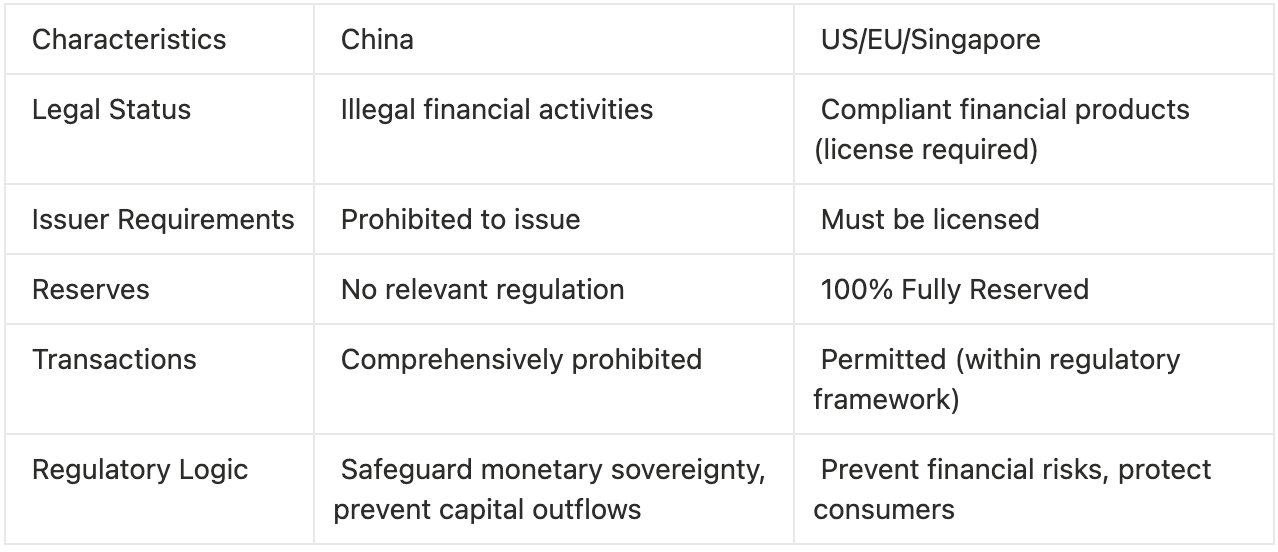 China is unique in that it is not regulating stablecoins, but banning them. This attitude is rooted in its adherence to monetary sovereignty, its bad defense of capital controls, and its strategic deployment of the digital RMB.
Conclusion: How to Judge the Risk
The purpose of writing this article is not to defend regulatory policy or encourage anyone to challenge red lines, but to present the facts. For cryptocurrency practitioners and investors, knowing this information is the first step in protecting yourself.
Here are some practical risk determination frameworks:
High-risk behaviors are these:
Buying and selling USDT frequently and in large amounts as an OTC merchant; providing RMB top-up channels for offshore platforms; and providing cross-border remittance services for others with USDT. Large cash transactions, especially at prices significantly higher than the market exchange rate. Once the bank card is winded or frozen and continues, it is the same as stepping on a mine.
Medium risks include:
Registering and trading on domestic exchanges (even if the platform claims to have cleared Chinese users); small and infrequent person-to-person transactions, but through bank transfers; and openly advertising or promoting USDT trading on social media.
Relatively low-risk scenarios:
Holding USDT on offshore exchanges that do not involve the conversion of RMB; participating in the DeFi protocol to use USDT, but with attention to the legality of the asset's origin; using USDT offshore for legitimate cross-border payments that do not touch funds in China.
Of particular note:
The gray area is disappearing. With the 2024 Judicial Interpretation classifying virtual asset trading as a form of money laundering, and the 2025 official characterization of stablecoins, the enforcement boundaries are becoming clearer.
"Unawareness" is not a talisman. Courts may determine that you should have known about the risks based on the characteristics of the transaction (large amounts, cash, unusual prices, accounts under wind control).
Policy is unlikely to ease anytime soon. China's heavy-handed approach to stablecoins is likely to continue for a long time, given its monetary sovereignty, capital controls and digital RMB strategy.
Global attitudes towards stablecoins are diverging: on one side, there is a compliance path in the US, EU, and Singapore, and on the other side, there is a total ban in China. This difference is rooted in different financial philosophies and strategic considerations.
For practitioners and investors who are in or connected to China, it is more important than anything else to recognize where this red line is, understand the logic behind it, and grasp the scale of enforcement.